
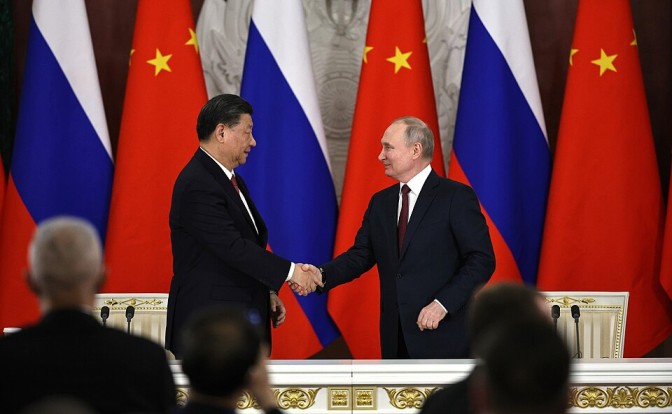
In a move to fortify political trust and strategic collaboration, President Xi Jinping and Russian President Vladimir Putin committed to extending the China-Russia Treaty of Good-Neighborliness and Friendly Cooperation. This decision was made during a meeting at Beijing’s Great Hall of the People, as Putin wrapped up a two-day visit to China. Their discussions culminated in the signing of a joint statement aimed at enhancing strategic coordination and deepening bilateral relations. Additionally, they oversaw the signing of 20 cooperation agreements spanning various sectors, such as the economy, trade, education, and science and technology.
The leaders jointly issued a statement advocating for a multipolar world and new international relations, further cementing their collaboration through 20 additional agreements in other fields. Xi highlighted the significance of Putin’s 25th visit to China since 2000, underscoring the exceptional level of China-Russia relations. Marking the 30th anniversary of their strategic partnership, Xi noted that their bilateral ties have reached unprecedented heights, serving as a model for major-country relations. This year also commemorates the 25th anniversary of their treaty, which was last renewed in 2021.
Xi emphasized the treaty’s principles of non-alliance and non-confrontation, stressing the importance of upholding equality, mutual respect, and cooperation. He noted the countries’ contributions to global fairness and justice, urging both nations to build on past achievements, support each other’s core interests, and maintain strategic communication. As bilateral trade exceeded $200 billion over the past three years, Xi called for continued alignment with China’s 15th Five-Year Plan and Russia’s development strategy through 2030, aiming to enhance mutual cooperation for national development.
Addressing global governance, Xi criticized unilateralism and hegemonism, advocating for China and Russia to uphold the UN’s authority and oppose unilateral bullying. He stressed the importance of defending the outcomes of World War II and combating fascism and militarism, proposing a more just global governance system. Putin echoed these sentiments, expressing confidence in the future of China-Russia relations and their ability to strengthen bonds, contribute to development, and uphold international law. He highlighted ongoing cooperation within international frameworks like the Shanghai Cooperation Organization and BRICS.
Lastly, China extended its visa-free policy for Russia until the end of 2027, with Russia reciprocating for Chinese citizens. During their talks, Xi and Putin also addressed pressing international issues, notably the Middle East conflict, advocating for negotiations to prevent renewed hostilities and ensure stability in global energy supplies and trade. To conclude the visit, Xi hosted a banquet for Putin at the Great Hall of the People.