
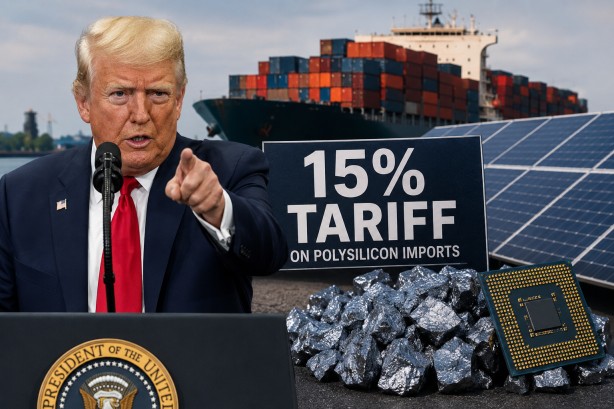
US President Donald Trump has implemented a 15% tariff on imported goods made with polysilicon, a vital component in the production of semiconductors and solar panels. This tariff, set to be enforced from December 4, is part of an effort to bolster domestic manufacturing capabilities and lessen dependence on Chinese imports.
Polysilicon, an extremely refined form of silicon, is crucial for creating semiconductors that drive artificial intelligence systems and data centers, as well as solar cells and panels. Currently, China stands as the top global producer of this essential material. As part of the new trade measures, the US will impose minimum import prices, including $21 per kilogram for polysilicon, $100 per kilogram for polysilicon ingots and wafers, $0.22 per watt for solar cells, and $0.38 per watt for solar modules and panels.
The US administration has stated that these actions are designed to promote the economic sustainability of domestic polysilicon production and to fortify critical supply chains that are tied to both economic and national security interests. In response, China has criticized the decision, arguing that the US is inappropriately using national security justifications to limit Chinese business operations, warning that this protectionist approach might disrupt bilateral trade.
In the US, two primary polysilicon production plants are currently operational, managed by Hemlock Semiconductor in Michigan and Wacker Chemie in Tennessee. The new policy framework also provides the US government with the ability to offer incentives to companies that invest in polysilicon production and associated manufacturing facilities within the country.
This tariff introduction coincides with China’s ongoing robust export growth, particularly in high-tech sectors such as electronics and artificial intelligence products, as well as other advanced manufacturing industries.