
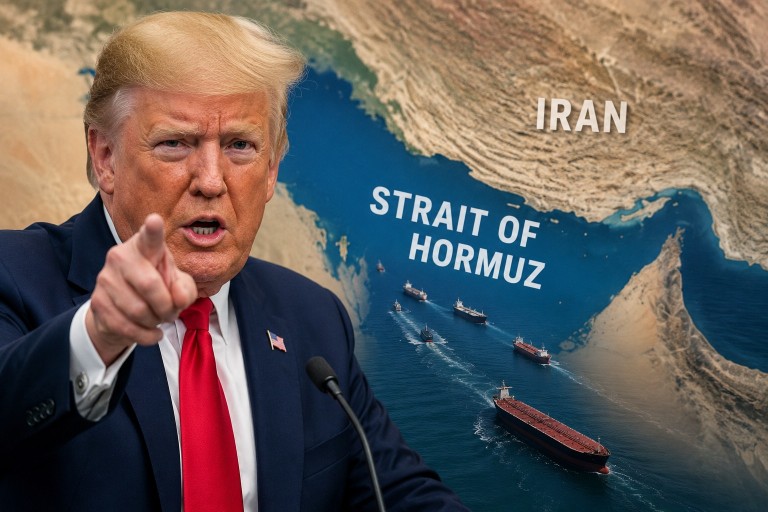
Amid escalating tensions and ongoing negotiations with Iran, US President Donald Trump has suggested that the United States may soon declare the Strait of Hormuz as its own territory. Speaking in New York, Trump indicated that this move could follow a successful campaign against Iran, asserting that the US already exercises effective control over the crucial waterway through an existing blockade.
The Strait of Hormuz holds significant geopolitical importance as it is a pivotal maritime route for approximately 20% of the world’s seaborne oil trade. Situated between Iran and Oman, the strait has become a focal point of military activities led by the US and Israel against Iran, resulting in restricted access. The ambiguity surrounding Trump’s statements raises questions about whether this marks a shift in US foreign policy or serves as a strategic political maneuver.
Iranian officials have dismissed Trump’s declaration as a mere threat, with Deputy Foreign Minister Kazem Gharibabadi affirming that Iran will not succumb to US pressure. He emphasized that Iran maintains authority over the decisions concerning the strait’s access. Meanwhile, Iran’s Foreign Minister Abbas Araqchi has clarified that Tehran has not yet opted to re-engage in direct talks with Washington, noting that any exchanges facilitated through intermediaries such as Qatar and Pakistan do not qualify as formal negotiations.
The ongoing conflict, coupled with the restricted movement through the Strait of Hormuz, has contributed to a surge in fuel prices, impacting consumers worldwide. President Trump has defended this economic consequence, arguing that the higher costs are justified as a measure to prevent Iran from advancing its nuclear ambitions. Despite the pressure on global energy supplies and the broader economic ramifications, the stalemate over the strait continues to pose a significant challenge.
Iran has stipulated several preconditions for reopening the strait to shipping, including demands for compensation for damages incurred during the conflict, the lifting of economic sanctions, and the release of Iranian assets that have been frozen. As the international community watches closely, the uncertainty over the Strait of Hormuz remains a critical issue, with potential implications for energy markets and geopolitical stability.