
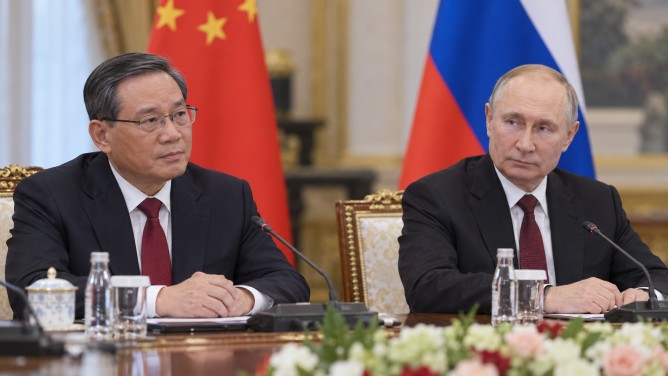
In a recent meeting held in St. Petersburg, Chinese Premier Li Qiang and Russian President Vladimir Putin reaffirmed their commitment to bolstering their strategic partnership amid an increasingly uncertain global landscape. Both leaders emphasized the importance of their countries’ collaboration as a vital source of stability in international affairs.
Premier Li conveyed warm greetings from Chinese President Xi Jinping and expressed China’s readiness to deepen strategic communication and political trust with Russia. He underscored the potential for enhanced cooperation across various sectors, particularly in trade, investment, energy, and natural resources. Li also highlighted the significance of maintaining momentum in economic cooperation to support development and prosperity in both nations.
Beyond economic ties, Li advocated for stronger cultural and educational exchanges, proposing that both countries expand people-to-people connections through tourism, sports, and youth initiatives. On the international stage, he stressed the necessity for China and Russia to enhance coordination through multilateral platforms such as the Shanghai Cooperation Organization and BRICS, while also advocating for collaboration with developing countries to promote fairness in global governance.
President Putin, acknowledging China as one of Russia’s closest and most reliable partners, noted that their bilateral relations are grounded in equality, mutual respect, and shared benefits. He expressed a strong interest in expanding cooperation in fields including energy, agriculture, space exploration, civilian nuclear technology, information technology, artificial intelligence, and transportation. Putin also reaffirmed Russia’s support for China’s upcoming role in hosting the Asia-Pacific Economic Cooperation (APEC) Economic Leaders’ Meeting and its future BRICS chairmanship.
The meeting between Li and Putin underscored the mutual intention of both governments to strengthen economic ties, expand diplomatic coordination, and deepen their strategic partnership as global challenges persist. Regular meetings between the two countries’ governments are deemed essential for implementing the agreements reached by their leaders, further solidifying their commitment to a robust and enduring partnership.